Full eight-part manuscript
Reasonable Control: Verification and Documentation of Machine-Assisted Work in Architectural Practice
A voluntary practice framework for licensed architects and architectural firms
Revision 2 · October 8, 2026
Part I The Condition Observed§
1.1 Existing Conditions§
The architect remains responsible for the work issued, including content produced with AI. This paper explains how to check that work and document the review.
Artificial intelligence has entered the ordinary work of architectural practice. Large language models draft specification sections from a firm’s master, summarize code provisions, screen submittals, and prepare responses to requests for information. They also draft the design narratives and construction-phase correspondence that may later become important in a dispute. Practitioners have taken up these tools task by task, often under the same deadline pressure that governs the rest of their work. Professional institutions have had to respond while that adoption was already under way.
AIA has issued professional guidance and a firm toolkit. NCARB has published an architectural regulatory position and model provisions; ICOR has issued cross-profession regulatory principles; and the NSPE Board of Ethical Review has addressed AI in an advisory engineering ethics opinion. Despite their different legal effect and professional scope, they share a practical concern: AI does not displace professional judgment or responsibility, and its output needs qualified human review appropriate to the work. The publications from AIA, NCARB, ICOR, and NSPE do not establish one nationally binding verification method for architects.
Insurance adds an immediate business reason to establish these controls. Professional liability insurers are examining how design firms use AI and manage its risks. A firm may be asked to explain how machine-assisted work is checked and provide evidence supporting that account. Firms should also review coverage with their brokers, including any exclusions affecting AI-assisted services. Verification and documentation can support the underwriting discussion; the policy’s terms govern coverage (§ 6.5).
For the architect reviewing a code study or specification, several questions remain. What constitutes verification? What should the check establish? What should the project record contain?
A defined method can answer those questions. A firm can evaluate it against its own jurisdictions, contracts, services, and risk profile before deciding whether and how to adopt it.
The concern is straightforward:
Artificial intelligence has not altered the architect’s standard of care—it has created new ways to breach it. When production outruns review, a firm can issue material machine-assisted content without having verified it or recorded how it was checked.
1.2 The Inspection Before the Failure§
Forensic practice begins after something has gone wrong. A forensic architect works through the project record to reconstruct how a deficiency entered the instruments of service, who had the duty to catch it, and what a reasonably prudent professional would have done differently. The documents may have looked complete when they were sealed, but what matters later is how they were prepared and reviewed.
The same discipline can guide the architect’s review before work is issued. This paper moves from the risks of machine-assisted work to practical methods for managing them. Part I identifies the risks. Part II sets out seven principles. Part III examines research on AI and professional judgment. Part IV applies the principles to architectural tasks. Part V explains the verification record. Part VI considers its role in disputes. Part VII addresses implementation in firms of different sizes. Part VIII defines the Guide’s scope and use.
1.3 What the Seal Attests§
The measure of an architect’s conduct is the standard of care: the skill and diligence that a reasonably prudent architect would exercise under similar circumstances. It is a technology-neutral measure. It does not ask what instrument produced a drawing; it asks whether the professional responsible for it exercised the judgment the public is entitled to rely upon. The seal is that reliance made physical: a licensed individual’s personal attestation of responsible control over the instruments of service, given under the authority of a license the state can revoke.
Licensing jurisdictions define responsible control differently. Across the provisions discussed here, the architect needs both authority over the work and enough professional knowledge to direct, evaluate, coordinate, and take responsibility for it. This paper uses Reasonable Control to name a proposed method of verification and documentation for machine-assisted architectural work. The method is intended to help architects exercise and demonstrate responsible control, the professional obligation described in applicable licensing law. Its requirements vary by jurisdiction, and adopting this method does not by itself establish compliance with those requirements or satisfaction of the standard of care. It does not require the architect to perform every task personally or understand every internal operation of a tool. The architect should be able to test the output, recognize its limits, and withhold approval when confidence is not justified. The extent of review depends on how difficult the output is to check and what could happen if it is wrong. Licensing rules may require the architect to direct the work as it is produced, rather than review it only at the end. Accepting the output without evaluating it does not establish responsible control.
1.4 The Anatomy of a Failure§
Consider a code study bound into a sealed permit set. It cites a building-code provision for the required fire-resistance rating of the structural frame. The provision does not exist in the adopted edition: the LLM has combined the base code with another jurisdiction’s amendment and presented the result confidently. The study is accepted under deadline. No protocol assigns anyone to trace the citation to the adopted edition, and no one does. The architect who seals the set sees the conclusion but never reads the provision. The set is permitted with the unverified conclusion still in the documents.
Months later, a plans examiner reviewing a revision, a contractor pricing a correction, or an expert investigating a dispute discovers the citation problem. The inquiry then follows a familiar course: how did the error enter the set, what review took place, and did the architect exercise reasonable care? In this example, no one traced the citation to the adopted code.
The missing procedure matters because it left that check unassigned. The evidence of the missed check, rather than the absence of a written procedure alone, establishes what happened.
The same problem can arise in a specification that cites a withdrawn standard, a submittal response issued under a reviewer’s stamp without qualified review, or a hastily drafted email that later becomes central to a dispute. These are familiar failures of professional review. Machine assistance changes how quickly the underlying work can be produced and released, making it more important to assign the check before the document leaves the office.
1.5 The Questions§
Think about the last permit set your firm sealed. Which portions were machine-assisted? Who verified them, and against which adopted code edition, current standard, or product data? If a plans examiner asked for that record, could you produce it? The same question may come from your carrier at renewal or, after a dispute, from opposing counsel with the set on the table.
An architect may have reviewed the work carefully and still be unable to answer from the project file. A general instruction to review AI output leaves each person to decide what the review entails and what to retain. The firm needs a defined method for both.
If a dispute leads to a deposition, the questions become specific: What method did the firm use? Who applied it? What shows that the review occurred? A firm that adopted, followed, and documented a written method can answer from the record. Otherwise, staff may have to reconstruct decisions long after the work was issued, with missing records becoming another subject of inquiry.
A defined method helps a firm connect its account of responsible control to the work actually performed. It does not provide a safe harbor, guarantee against liability, or establish that professional obligations were satisfied.
A published method may become relevant when a firm adopts it, incorporates it into an agreement or policy, or when professional practice or a properly qualified witness recognizes it. Publication alone does not establish custom or the standard of care. Its significance depends on the jurisdiction, project, and evidence of implementation.
1.6 What Reasonably Prudent Now Means§
An LLM can draft a specification section quickly. The architect still has to decide whether it belongs in this project, whether it works with adjacent systems, and whether its claims can be verified. A code summary presents the same problem: the adopted edition, local amendments, and project facts determine whether the conclusion is useful. As drafting becomes faster and less costly, that work of evaluation and coordination remains central to the architect’s contribution.
For a firm choosing to conform to this Guide, the questions are practical. Are machine-assisted tasks defined? Does an appropriately qualified professional verify material contributions against authoritative sources before reliance? Is confidential information protected? Can the project record show the decisions and checks that mattered? The method applies familiar elements of responsible control to the tools now in use; it does not propose new professional duties.
Verification tests whether the work is reliable; documentation shows how it was checked. A missing record does not prove that no review occurred, but it leaves the firm dependent on memory and reconstruction. Recording the contribution, test, source, verifier, and result as the work proceeds provides evidence proportionate to the work.
Part II Seven Principles§
The seven principles apply familiar architectural practices—directing work, checking drawings and specifications, protecting client information, and keeping project records—to machine-assisted work. Each states the proposed practice, explains its use, and identifies supporting authority. The sources include applicable licensing laws, proposed model rules, professional guidance, and NSPE ethics opinions. The legal weight for each differs (§ 8.4).
2.1 Responsible Control§
The architect should exercise responsible control over every material machine-assisted contribution to an instrument of service. Generated output is an unverified draft. A qualified professional should evaluate it, verify its material assertions, and decide whether it is suitable for incorporation into the work.1
What it means. When a project architect directs a wall-section detail, responsible control involves more than checking the finished drawing. The architect establishes the design intent, directs its development, and decides whether the detail works with the rest of the building. An AI-assisted detail calls for the same direction and judgment.
Illinois requires control over the content and detailed professional knowledge during preparation; a final review alone is insufficient. California likewise defines responsible control through control over content during preparation. NCARB’s model provisions require ultimate authority and the knowledge and ability to oversee, delegate, and integrate design and technical decisions.2
The 2025 NCEES Model Law similarly describes authority to review, change, reject, or approve work, knowledge of project limitations, the ability to explain decisions, and acceptance of responsibility.3
Architectural sealing provisions address work prepared by the architect, individuals under the architect’s responsible control, or another architect whose work is reviewed and coordinated or integrated.4 AI qualifies as none of those participants. Its output requires qualified review, integration, and verification before incorporation.
What it requires.
– Treat AI output as unverified draft material. Before a material contribution enters sealed work, a qualified professional should understand the content, integrate it into the work, and verify it under § 2.2.
- Do not adopt AI output merely because it reads well, seems plausible, agrees with expectations, or has received a general review. Apply the control and verification required for the content.
- Record the check as it occurs: what the machine contributed, what was checked, against which sources, by whom, and with what result.S1
2.2 Verification§
Under this Guide, material AI contributions to sealed work are verified before reliance. For output outside the sealed set, § 4.G determines whether verification is required. Verification is complete only when three elements are present: a stated criterion, an authoritative source, and a recorded result.
What it means. For an AI-assisted egress analysis, the criterion is whether the proposed route satisfies the governing requirements. The architect checks the adopted code and project drawings, then records the result and any correction. A plausible narrative does not establish that the route complies.
AIA recommends review and validation by qualified professionals.5 ICOR states that human oversight should not be automated.6 NCEES calls for critical assessment, independent checks, and documented methods and data.7 In the NSPE ethics case, the board concluded on the facts presented that the engineer acted unethically by sealing AI-assisted work without responsible charge.8 None of these sources sets out the complete three-part test.
The NSPE case illustrates the difference between testing and skimming: the engineer retained responsible charge of the document he verified thoroughly, but not of the one he merely skimmed.
What it requires.
- No material machine-assisted contribution enters sealed work, or a gated material professional communication, untested.
- The test is against the primary document; a second AI’s agreement is not a source.
- Record the result during the review in the linked project records described in Part V.
- Verification addresses the proposition relied upon, not merely whether a quoted sentence or cited source exists. Where material, it tests applicability to project facts, completeness, relevant exceptions, and coordination with dependent information.
- Match the check to the consequence and use of the assertion. Existing code analyses, specification reviews, and coordination checks may supply the test and record. Grouping and sampling follow § 5.3.3. An adequate check need not be repeated or entered on a separate form merely because AI was used.S2
2.3 Source Identification§
The architect should be able to identify the material machine-assisted content relied upon in sealed work or gated professional output and the sources used to verify it. Identification may cover a drawing, schedule, specification section, or defined group of items when the scope and checks remain clear (§ 5.3.3).
What it means. A specification may contain an AI-supplied performance value without identifying the product data that supports it. The architect needs that connection to check whether the value applies to the product and assembly specified.
ICOR calls for the origin and history of data to be tracked and documented.9 In the NSPE ethics case, the omission of citations to technical authority was deficient on the facts presented even apart from whether the AI-drafted conclusions were correct.10
What it requires.
– Every material assertion relied upon traces to its source: the code conclusion to the adopted edition and section, the standard to its status, the product to current data, the contract statement to the document and section.S3
2.4 Competence§
The architect should not use an AI tool to prepare an instrument of service without competence in that tool: knowledge of its capabilities, its limitations, and its typical errors, sufficient to evaluate its output.
What it means. For an AI-assisted code analysis, competence includes recognizing an incorrect occupancy classification or a code exception the project does not qualify for. Prompting skill alone is not enough. Applicable licensing rules govern competence; NCARB’s model rule requires knowledge and skill in the technical areas involved.11 Allied engineering ethics opinions treat production tools as aids to professional judgment; ICOR describes tool competence in terms of capabilities and limitations.12
In one study, AI legal research tools gave false or unsupported answers 17 to 33 percent of the time; a general-purpose model did so 43 percent of the time. Errors included made-up citations and outdated or inapplicable sources. Tools may also accept a mistaken premise. These findings describe the tools tested, not architectural work or later versions.13
NCARB encourages transparency about how AI tools operate14 while cautioning regulators against unnecessarily limiting technological advances.15 These sources inform tool competence; they do not impose a uniform rule in every jurisdiction.
What it requires.
- Evaluate tool suitability using representative tasks and known failure modes; do not treat a software provider’s accuracy claim as proof of suitability for the project.
- Maintain the firm’s knowledge of tool capabilities, limitations, and typical errors through its competence process; review this process under § 7.5.S4
2.5 Confidentiality§
The architect should not submit confidential, privileged, proprietary, personal, or security-sensitive information to an AI tool unless the submission is authorized and the tool, account, connection, and settings have been approved for that type of information. An open interface should not be treated as confidential merely because access to it requires an account.
What it means. A client’s unpublished plans, security layouts, or project correspondence may carry restrictions on use or disclosure. Asking AI to summarize a file, or connecting it to a project folder, can give the service access to that information.
In Case 24-2, the NSPE Board of Ethical Review found that uploading a client’s information to an open AI interface effectively made it public without the client’s consent. 16 AIA guidance advises firms to review AI systems before uploading confidential information, including how those systems store data and use it for training. 17
Before approving that use, the firm should check what the system can access, how it handles the information, and whether the arrangement meets applicable law, contracts, client restrictions, and professional duties. Review includes privilege, data protection, service terms, and settings. Approval for public product research does not by itself authorize uploading a confidential drawing set.
What it requires.
- A written register identifying approved tools, connections, uses, information types, and settings, with ownership, service terms, review dates, and approval status. The full register requirements are in § 4.F and Appendix A, § A.8.
- A defined boundary between each approved account or connection and any open or unapproved interface, enforced through access controls, settings, training, and periodic review.S5
2.6 The Record§
A verification record shows what the architect checked, how it was checked, and what the review established. It identifies the project and document, the machine-assisted content, the sources, the reviewer, the date, and any correction or unresolved issue. The record is made during the work and remains retrievable. It is required for uses classified as gated under § 4.G.
What it means. Marked-up drawings, code analyses, and review checklists already document how architectural work was checked and corrected. This Guide applies that practice to machine-assisted work: identify the contribution, the person checking it, the source consulted, and the result. A later reviewer should be able to follow how the architect evaluated the work. Part V specifies what to retain.18
The record also supports the firm’s insurance discussions. It allows a principal to substantiate statements about the firm’s review procedures with evidence of checks actually performed (§ 6.5).
NCARB Model Law § 403 proposes records adequate to demonstrate responsible control, including when submissions integrate others’ work. It becomes binding only through jurisdictional adoption.19
What it requires.
- Open the project-level record when machine assistance is first used for a gated purpose. Record the project and instrument context once, and update it whenever the scope, tool, source set, or intended use materially changes.
- Make verification entries during the review. Marked-up drawings, code worksheets, submittal logs, and other existing project records may provide the entry when they identify the content checked, method, source, verifier, date, result, and action or status. Add missing information rather than duplicate the check in a separate AI log.
- Do not mistake a prompt history, model output, or system-generated activity log for a verification record. Those materials may support the record, but they do not establish that a qualified professional tested the content against appropriate authority.
- Preserve the record with the project files, protect it against unauthorized alteration or loss, and retain it for the period established by governing requirements and the firm’s applicable retention policy.S6
2.7 Decisions Reserved for the Architect§
For conformance to this Guide, compliance determinations and professional review actions rest on independent professional judgment. Using AI as the sole or primary basis for a compliance determination, or to select or issue a review action, is outside this Guide’s permitted uses. Machine-assisted content requires qualified professional review, integration, and verification before entering sealed work.
What it means. When a tool flags a difference between a submittal and a specification, the architect decides what review action to take. Identifying the difference does not resolve its significance for the project. AI may then draft the wording (§ 4.C). These are this Guide’s proposed restrictions. The cited NCARB model rule concerns reliance on qualified persons, not AI.20 Applicable law still governs.
What it requires.
- Base each compliance conclusion on the governing requirements and project facts, with any necessary interpretation made by a qualified professional (§ 4.A).
- Select the review action before asking AI to draft its wording. A later check or signature does not replace that decision (§ 4.C).
- Treat unclassified uses as gated under § 4.G. Verification does not authorize a use that assigns a reserved decision to AI.S7
Part III Artificial Intelligence and Professional Judgment§
Architects need to review machine-assisted work without allowing a plausible answer to displace professional judgment. Medicine offers a useful comparison: physicians also make consequential decisions from complex information and remain responsible when AI assists them. Research in medicine and human factors shows how automated advice can influence that judgment. Those findings inform this Guide’s controls, but do not establish the architect’s standard of care or validate the controls for architectural practice.
3.1 Reliance on Automated Advice§
Automation bias occurs when people accept automated advice without adequately checking it. In their 2017 systematic review of 40 studies, Lyell and Coiera examined how this risk varied with the task and the difficulty of checking the advice. Bias appeared during multitasking even when individual checks were simple; with single tasks, it appeared when verification was more demanding.21 Romeo and Conti describe the broader pattern: as verification becomes more difficult, reviewers are more likely to accept automated output without adequate independent evaluation.22 An easy task is not necessarily free from automation bias.
A 2024 review of 106 experiments found that people working with AI performed, on average, worse than the better-performing of the human or the system alone.23 In terms of task types, decision tasks showed average losses and creation tasks showed average gains; the difference was statistically significant.24
In architectural practice, this concern arises when a convincing explanation takes the place of checking the underlying requirement. An AI-generated code analysis may contain consistent calculations while relying on a provision that does not govern the project. The architect’s review should therefore test the governing premise as well as the calculations.
3.2 Training and Incorrect Advice§
Automation bias was not significantly reduced by the training interventions reviewed by Lyell and Coiera. The interventions included extra practice without automation, examples of automation failures, and instruction on recognizing and avoiding the bias.25
A later randomized trial involved 44 licensed physicians who had completed a twenty-hour AI-literacy course covering LLM capabilities, prompt engineering, and critical evaluation of generated output. Each diagnosed six clinical vignettes with optional LLM recommendations. The control group received error-free recommendations; the experimental group received deliberately erroneous recommendations in three cases.
Compared with the control group, the experimental group's adjusted diagnostic-reasoning score was 14.0 percentage points lower and its adjusted first-choice diagnostic accuracy was 18.3 percentage points lower.26
Because every participant had completed the course, the trial cannot establish the course's effect. It shows that trained physicians remained susceptible to incorrect advice. Education therefore needs to be accompanied by a check capable of detecting a plausible error.
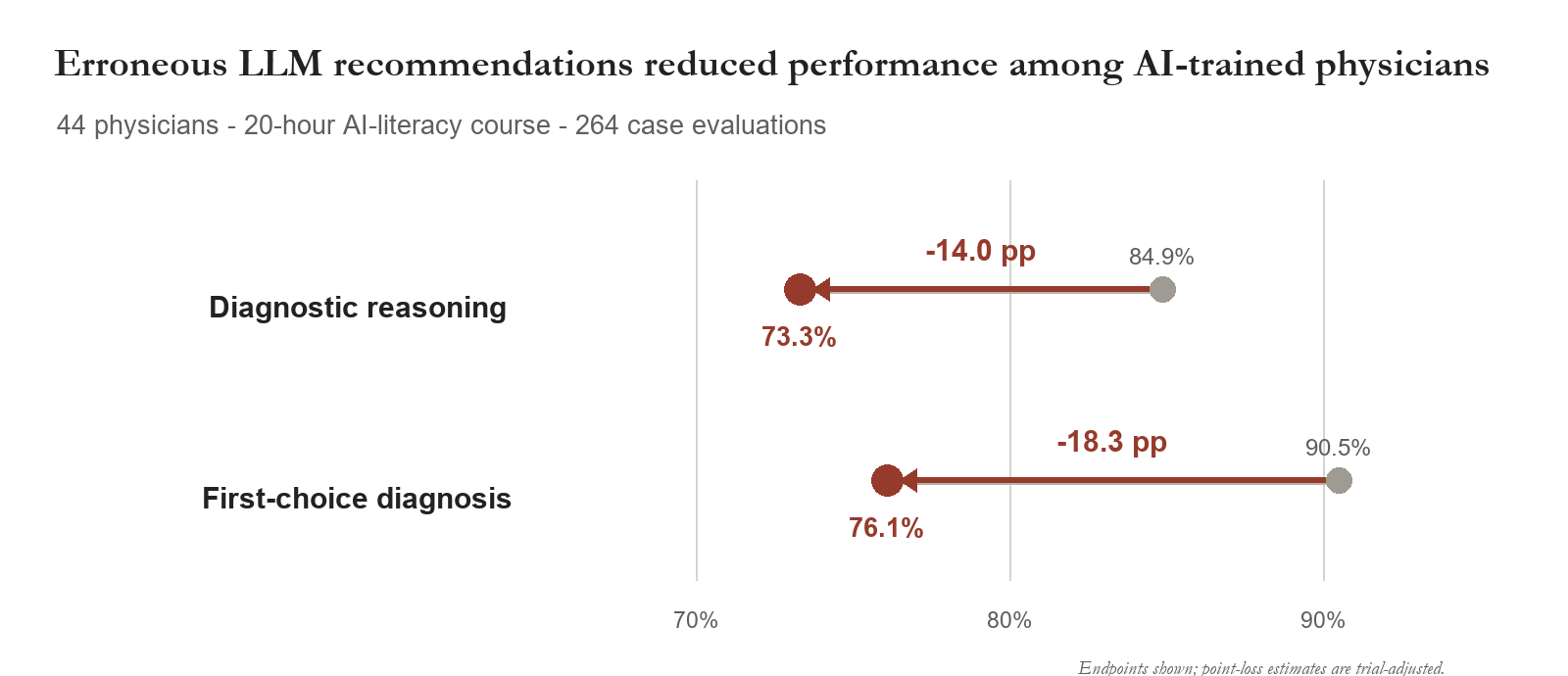
Figure 1. All 44 physicians had completed the same twenty-hour AI-literacy course. The comparison is erroneous versus error-free LLM recommendations, not trained versus untrained physicians. Endpoints are unadjusted percentages; the labeled decreases are adjusted estimates. Data: Qazi et al., NEJM AI (2026).
An earlier study measured how often professionals changed a correct answer to an incorrect answer after reviewing automated advice.

Figure 2. The switching rate. Data: Goddard, Roudsari and Wyatt (2014).
Professionals reviewing automated advice changed a correct answer to an incorrect one in 5.2 percent of all cases. The less experienced the reviewer, the more often it happened.27
An architect might identify a discrepancy between a submittal and the specification, then reconsider after receiving a persuasive AI explanation. Before changing the review action, the architect should resolve that disagreement against the governing project documents. Training in AI use supports this process but does not replace the check.
3.3 Information Provided During the Task§
The prior review found no significant reduction in automation bias from the tested training interventions.28 A separate randomized trial tested information provided during the task: 72 AI-trained physicians completed 432 case evaluations with information about the model's benchmark accuracy and a case-specific confidence signal. Compared with an LLM recommendation alone, the two cues improved diagnostic-reasoning accuracy by 7.6 percentage points and first-choice accuracy by 10.9 percentage points.29

Figure 3. The panels report separate evidence: a prior review of training interventions and a separate randomized trial of a dual behavioral nudge. The trial did not test authoritative-source verification. Data: Lyell and Coiera (2017); Qazi et al., medRxiv preprint (2026).
The benefit was larger among less experienced physicians, a subgroup finding.30 The trial suggests that information supplied during a task can change reliance behavior, but it did not test authoritative-source verification.
For an architect reviewing an AI-drafted specification clause, the relevant source needs to be available while the clause is being evaluated, before it enters the project specification. The Guide therefore places verification at that decision: the reviewer checks the proposed requirement against the governing source and records the result before relying on it. Whether this procedure improves architectural outcomes or works under deadline pressure remains untested.
Part IV Reasonable Control by Area of Practice§
These controls form the Guide’s method of Reasonable Control: a documented approach to maintaining responsible control over machine-assisted work. Verification should fit the work. A zoning conclusion, a firestopping specification, and a submittal decision can fail in different ways and require different checks.
The scenarios illustrate possible failures; they are not accounts of decided cases. The controls apply the Guide’s criteria and recommendations (§ 8.5). External requirements are identified only where an applicable enacted law, adopted rule, or contract is specified. Where the work has a defined document structure, the check follows that structure.
4.A Code, Zoning, and Regulatory Analysis§
A machine-assisted feasibility study for a mixed-use tower can produce consistent calculations from the wrong zoning premise. It calculates floor-area ratio, height, parking, gross area, and yield from the base district, but misses an overlay, a condition on combining parcels, or the local definition of floor area. The numbers agree because they share the same error. A code study can do the same thing with a real provision from an unadopted edition or with model text that omits a controlling local amendment. Evaluation of AI-assisted legal research has documented both unsupported authority and real but inapplicable authority on directly verifiable questions.31 For a project code analysis, the governing requirement is ordinarily the edition adopted by the authority having jurisdiction, as locally amended.32 Finding a real citation is only the beginning of the check; the architect should establish that it governs this project.
Controls. The architect should not rely on machine output as the sole or primary basis for a compliance determination (§ 2.7). Before a material machine-assisted regulatory claim is incorporated into an instrument of service or relied upon in a gated professional communication, verification should establish the governing sources and their applicability: the jurisdiction and adopting authority; the adopted edition and effective date; applicable local amendments and administrative criteria; incorporated standards; and the project facts, definitions, exceptions, and dependencies that determine applicability. The verifier should read the cited provision and each material cross-reference on which the conclusion depends.
Where the conclusion requires interpretation, a qualified professional should make that judgment. The record should identify the claim tested, governing sources, material applicability facts, method, verifier, date, disposition, and affected later calculations, drawings, or decisions.S8
4.B Specifications§
A specification section for penetration firestopping names a current product and cites ASTM E814 or UL 1479. The product and test method are real, but that does not establish protection for the proposed condition. The controlling evidence is a listed system—or, where appropriate and accepted, a project-specific judgment with a justifiable technical basis—whose conditions match the rated wall or floor, penetrating item, material and size, opening and annular space, sleeve condition, packing, sealant depth, and required rating.33 A check limited to the product can miss the assembly problem. Withdrawn standards, discontinued products, and obsolete manufacturer data present simpler versions of the same concern: the section looks complete before its claims have been verified.
Controls. Review machine-assisted specification sections before incorporation, focusing on technical content AI introduced or changed, its project applicability, and affected requirements elsewhere in the section. Previously checked master content may rely on that check where its source, applicability, and meaning remain current and unchanged. For changed content, trace the requirement through Parts 1, 2, and 3: confirm governing references, current product data, assembly performance, and installation conditions. Review affected interfaces, related sections, and drawing coordination. Where performance belongs to an assembly, product data alone is insufficient. Record the scope, sources, findings, and corrections as one section review, distinguishing different results where needed (§ 5.3.3). Unsupported material content should be corrected, removed, or escalated for resolution before reliance.S9
4.C Submittal and Shop Drawing Review§
Suppose a machine compares a resubmitted electrified-door-hardware submittal package with the specification and the architect’s prior comments. It reports that every comment has been resolved and proposes “approved as noted.” Elsewhere in the package, an unmarked revision changes an electrified lock from the specified fail-safe function to fail-secure. The comparison may have answered the question it was given. It has not established that every revision was disclosed, that deviations from the Contract Documents were identified, or that the architect intended to approve this particular change. The problem is the scope of the review behind the disposition.
Submittals are not Contract Documents. They show how the contractor proposes to conform to the information and design concept expressed in those documents, and the architect’s review has a correspondingly limited purpose. Under commonly used general conditions, approval of a submittal does not approve an undisclosed deviation; the contractor must specifically identify deviations and, on resubmittal, revisions other than those requested by the architect.34 Machine comparison can accelerate screening. It cannot determine what the architect has knowingly accepted.
Controls. Machine assistance may compile the specification requirements relevant to the submittal, compare submitted data against those requirements, track responses to prior comments, and flag apparent changes. Before taking action, the architect should determine that the submittal has received the contractor’s review required by the governing Contract Documents; that the package is sufficient for the review action sought; that stated deviations have been isolated for express decision; and that revisions outside the architect’s prior comments have been identified and reviewed. The architect should understand the scope of any machine comparison, including pages, fields, criteria, prior versions, and related submittals omitted from it, and should obtain review by affected consultants where required. A machine may draft the wording of a review action only after the architect has selected the review action through independent professional judgment; it should not select or issue the review action. The record should identify the version reviewed, comparison scope, prior comments tested, disclosed deviations, material additional revisions, reviewer, and final disposition. S10
4.D Drawing Production, Coordination, and QA/QC§
A parametric facade revision changes the module, floor-to-floor zone, or panel geometry and updates the elevations, schedules, quantities, and fabrication geometry. The updated views agree, yet the revision can still fail at a slab-edge embed, perimeter fire-containment condition, movement joint, maintenance-equipment clearance, or construction tolerance that the automated update does not address. A cross-sheet check may find no discrepancy because the sheets share the same input. The architect has to check both the input and the affected interfaces; agreement among the outputs cannot establish either.
Controls. Check machine-generated or propagated changes before reliance or issuance, with review proportionate to their extent and consequence. Identify the governing input, affected outputs, and interfaces outside the automated update. For repeated content, verification may combine a check of the input and propagation method with representative output checks under § 5.3.3. Review unique material conditions and affected interfaces directly; agreement among outputs alone does not establish correctness. A coordinated review may cover a defined set of changes and be recorded in the existing model issue log or drawing markup. The record identifies its scope, sources, method, verifier, date, findings, and corrections.S11
4.E Construction-Phase Correspondence§
An RFI asks whether a smoke-control duct can shift through a rated shaft wall to avoid a structural beam. A machine finds a similar response and drafts an instruction that sounds workable. The answer, however, should reconcile the smoke-control sequence, structural constraint, shaft protection, damper and access conditions, and applicable firestop system. It should also distinguish an interpretation of the existing Contract Documents from a change to the Work, cost, or time. Without those decisions, an apparently practical response can leave a life-safety issue unresolved and authorize a change through the wrong instrument.
The form of the response matters because the contract assigns different effects to different instruments. Common general conditions separate interpretations and RFI responses from Supplemental Instructions, minor changes, Change Orders, and Construction Change Directives; the standard AIA RFI form states that neither the request nor the response authorizes work that increases cost or time.35 Before issuing the draft, the architect should decide what professional action it represents and which project instrument is authorized to carry that action.
Controls. A machine-assisted RFI response, field directive, or other project correspondence is gated outside the sealed set when it could materially affect life safety, code compliance, building performance, construction cost or time, contractual rights, or a professional determination. Before issuance, the architect should verify the material factual premises, implicated Contract Documents, contractual authority, affected disciplines, and known effects on related work. The architect should determine whether the matter can be answered as an interpretation or requires a Supplemental Instruction, minor change, Change Order, Construction Change Directive, proposal request, or other instrument authorized by the governing Contract Documents. Review by affected consultants should be obtained where the response crosses their scope. Routine minor confirming correspondence remains permitted under § 4.G and does not require the Part V record. A machine should not issue correspondence under the architect’s authority without the required professional review. The record should identify the question, sources reviewed, affected work and disciplines, contractual classification, reviewer, date, and disposition.S12
4.F Confidentiality and Data Handling§
A team connects a cloud-based assistant to the combined project model for a courthouse, data center, health facility, or other security-sensitive project to ask one coordination question. The prompt contains no confidential detail. The connector nevertheless indexes geometry, room names, security zones, equipment, issue history, metadata, and linked consultant models. Its account, organizational setup, retention rules, processing location, or service providers may differ from what the team assumed. By the time the answer appears, protected information may already have been exposed. The resulting drawing or specification may give no indication that this happened.
Professional guidance calls for qualified review, approved systems and uses, protection of confidential information, and an understanding of how platforms store, reuse, or train on submitted data. These safeguards also matter when AI is embedded in modeling, specification, code-checking, or document-management software.36 Approval should therefore address everything the connected system can access and the specific account, connection, and settings.
Controls. Before protected information becomes accessible to a machine-assisted system, the firm should classify the data and confirm that the specific provider, tool, user and organizational accounts, interface, connections, and settings are approved for that class and consistent with client restrictions, privilege obligations, contract, and applicable law.
Approval should establish the system’s access to project information, including indexed files, linked models, and connected services. Use available provider documentation, service terms, settings, and qualified advice to evaluate material risks: access controls, storage and processing, retention and deletion, model training, incident response, and intellectual-property terms. The depth of review should reflect the data’s sensitivity and client restrictions; it does not require an independent audit of the provider’s entire infrastructure. Where required protection cannot be established, restrict access or use an approved alternative.
Qualified legal, security, privacy, and technology procurement specialists may perform or advise on these reviews. The designated professional should ensure that the reviews and approvals occur and are documented; the architect remains accountable for professional use of the output.
The firm should maintain the tool register specified in Appendix A, § A.8. A firm-wide entry may cover repeated uses within the same approved account, configuration, data classes, and access scope. Identify the tool and provider, responsible person, approved uses and restrictions, required settings, approval and review dates, and status; link supporting terms and security reviews instead of copying them into every project file. Record material unknowns and how they limit use. A different interface or a change affecting protection requires review; suspend or narrow use when the approval no longer applies.
4.G Task Classification§
Every use of machine assistance in practice falls into one of three tiers.
- A permitted task produces no material machine-assisted contribution to sealed work and no material professional communication outside the sealed set. Routine internal drafting, formatting, indexing, administrative work, and minor confirming correspondence are ordinarily permitted; the Guide’s verification record is not required, although ordinary professional, contractual, confidentiality, and quality-control duties still apply.
- A gated task produces output that may materially enter sealed work, or a professional communication outside the sealed set that could materially affect life safety, code compliance, building performance, construction cost or time, contractual rights, or a professional determination. It is permitted only with the applicable verification under § 2.2 and record under Part V.
- A prohibited use replaces the architect’s judgment with an AI decision about whether a design meets code or a submittal should be approved. It also includes putting AI-generated content into sealed documents without a qualified professional checking it and integrating it into the work (§ 2.7).
- An unclassified use is gated until classified.
The same software and project information can support all three tiers. Indexing photographs and room labels for an internal existing-conditions survey log is ordinarily permitted.
Extracting dimensions or observed conditions into a plan that may enter sealed work is gated. Allowing the machine to resolve ambiguous geometry, infer a concealed condition, or represent survey accuracy without the required professional judgment and verification is prohibited. The product name and apparent simplicity of the prompt do not settle the classification. The intended use, material consequence, and role of professional judgment do.
Classify a recurring task once for its intended use, material consequence, and role of professional judgment; revisit the classification when these change. Content that may materially enter sealed work is at least gated. Outside the sealed set, only material professional communications within the stated categories are gated. A use that assigns a reserved professional determination to the machine is prohibited. For a gated task, the likely error determines the verification protocol.
These proposed categories reflect professional guidance that leaves judgment and responsibility with the licensed practitioner and calls for closer review of unclear or consequential uses.37 They are neither research findings nor a nationally uniform legal rule.
The gated category allows AI to assist with a task while the architect retains professional judgment and responsibility. Delegated design offers a limited comparison. Under the governing Contract Documents, the architect states the performance and design criteria, and reliance is tied to an appropriately licensed professional’s services, certifications, and approvals.38 AI output carries no such seal or responsibility. This explains the need for qualified verification without determining the output’s legal status.
For a gated use, verification covers the material assertions relied upon. The extent of checking depends on consequence and intended use; linked records, grouped checks, and sampling of repeated content may be used as provided in §§ 2.2 and 5.3.3.S13

Figure 4. Sealed work is the primary trigger. Outside the sealed set, the limited gate applies only to a professional communication that could materially affect a § 4.G consequence category. Reserved professional judgment closes the use to AI. Derived from § 4.G.
Part V The Record§
The record should be practical to keep and clear to someone who was not present for the check. It should show what was checked, when and how, and with what result. Retention and client disclosure are separate questions.
5.1 What a Complete Record Establishes§
For this Guide, a complete record establishes, for any gated use, which content or defined group of items was machine-assisted; the project, instrument, version, and tool context; what test was performed before reliance; who performed it and any required approval; and the result, status, exceptions, corrections, and further verification where applicable.
NCARB Model Law § 403 proposes records adequate to demonstrate responsible control over submissions prepared by the architect or through integration of others’ work.
NCARB’s Model Regulations and Illinois law contain related provisions, each within its own scope and legal status.39 The fields, grouping rules, sampling limits, and further-verification triggers below are proposed practice requirements, not requirements attributed to those sources.
5.2 Recording Checks When They Occur§
Under this Guide, a timely record is made at or near the verification, in the ordinary course of practice. A record assembled after a claim has been asserted does not meet this criterion.
Records made during the work may assist later authentication and hearsay analysis, but admissibility is not automatic. Federal Rule of Evidence 803(6) requires each condition of the business-record exception. The timing, knowledge, regularly conducted activity, and regular-practice elements must be supported by qualifying testimony or certification, and the opponent may show that the source, method, or circumstances indicate a lack of trustworthiness. Rule 902(11) can provide a method of self-authentication when its requirements and notice provisions are met; it does not decide relevance, hearsay, trustworthiness, or evidentiary weight.40 State proceedings may apply different rules.
Preservation, spoliation, and adverse-inference questions arise under separate jurisdiction-specific law and depend on the facts; no general adverse-inference rule is proposed.
When reviewing implementation, ask whether the firm can retrieve the record without rebuilding it from staff memory or file metadata. That tests the record system. It is not a legal test of when the record was made.
5.3 Minimum Record Content§
A complete record links project context to the checks performed. Context, sources, routine criteria, tool information, and reviewer qualifications may be recorded once and referenced by later entries while still applicable. Existing project files may supply either part; the record need not be a separate form or software system.
A notation such as “checked” does not identify the test or its result. The fields below provide the detail needed to understand the review.
For evaluated third-party documents, New York requires a record identifying the project and documents, source, party for whom the evaluation was conducted, date, and evaluator’s seal and signature.41 The proposed two-part record is broader than that rule.
The NSPE ethics opinion found AI-drafted content deficient on its stated facts when citations to pertinent technical authority were omitted, regardless of whether the conclusions were correct.42 It supports recording the connection to authority, but does not prescribe the full record.
5.3.1 Project and Instrument Context§
The context record contains the following information for the project, instrument, issuance, or other defined body of work to which verification entries link:
- project identifier; deliverable or instrument title; revision or version; and issue date or status;
- the task classification and governing verification protocol;
- the tool and provider; product, model, and version to the extent known; and any configuration material to the output or review; and
- a retrievable reference to the relevant input and output where needed to identify what was checked, such as a saved file, drawing revision, or project-record identifier.
Keep only the information needed for this part of the record, without indiscriminately retaining prompts, privileged communications, confidential project data, personal information, or proprietary material. When full input or output retention is inappropriate, the firm should retain a controlled reference or description sufficient to identify the content and verification without unnecessarily duplicating protected material.
5.3.2 Verification Entry§
An entry identifies, directly or by reference:
- the content, assertion, item, or defined group of items verified, with its location in the instrument or communication;
- the pass criterion—the proposition the content must satisfy;
- the authoritative source or other governing evidence, with jurisdiction where applicable, edition or version, date, and exact section or page;
- the verification method and evidence sufficient to show how the criterion was tested;
- the verifier’s identity, role, qualification relevant to the subject, and verification date or timestamp;
- the disposition: confirmed, corrected, removed, escalated, or unresolved; and
- corrections, further verification, approvals where required, and unresolved items or exceptions, if any.
Illustrative completed record (fictional project and tool).
Context: Project 2604, office renovation.

5.3.3 Grouped Entries, Sampling, and Further Verification§
One entry may cover a drawing review, specification section, schedule, or batch of similar checks. Identify its scope, criteria, sources, and methods; distinguish differing reviewers, results, corrections, and exceptions. State whether review was complete or sampled. Grouping changes the record, not the scope of verification.
Sampling may be used for repeated content with its scope and risk basis noted in the record. Sampling does not replace verification of a unique material assertion affecting life safety, code compliance, building performance, contractual rights, or another professional determination. A failed sample calls for broader review appropriate to the error and a record of correction or escalation.
Further verification addresses changes to content, sources, or project facts that could affect the prior result, including consequences for dependent work. It may rely on unchanged portions of a still-applicable check. Link the new entry to the earlier review, identify the scope rechecked and current result, and keep unresolved items visible until closed or expressly carried into the release decision.
5.4 Retention§
The record is identifiable within the project files and retained under a written schedule approved for the firm’s work and jurisdictions. The schedule should cover applicable licensing requirements, contract duties, limitation and repose periods and their triggering events, insurer guidance, privacy and data-minimization duties, and legal holds. No universal retention period, trigger, or safe harbor is established.
A firm should first identify which retention requirements govern its work. NCARB Model Law § 403 proposes at least five years for records adequate to demonstrate responsible control; Texas and New York have adopted requirements of their own, within their stated scope.43 Retaining a file for the required period does not answer a separate question: whether its contents adequately show responsible control.
Limitation and repose rules vary by jurisdiction, claim, duration, and triggering event. Substantial completion is relevant in some regimes but is not a universal trigger.44 Some jurisdictions may lack a construction-specific statute of repose, and risk-management recommendations should be read within their stated assumptions.45 A firm may use a documented project- or jurisdiction-specific schedule, or a uniform schedule shown to be adequate for all work it covers. The selection should be reviewed with qualified counsel and the firm’s broker or insurer as appropriate; neither a board minimum nor a single risk-management rule can be assumed sufficient nationwide.
The verification record should not be treated as a disposable draft. The written schedule should state how it is classified, where it is stored, and how secure disposition occurs when the schedule expires. A legal hold suspends routine destruction for the affected records regardless of the ordinary schedule. The policy should identify who may issue and release a hold, the systems, backups, and provider-held copies within scope, and the documented process for disposition after the hold is released. Retention of full prompts or protected source material is required only when appropriate under the schedule, data-minimization rule, and legal hold.
5.5 Client Disclosure, Verification, and Recordkeeping§
When this Guide requires verification, conformance depends on both performing the check and recording its result. Client disclosure is a distinct question governed by contract, applicable law or rule, and the circumstances. These duties are not substitutes for one another.
To assess whether an AI-assisted task calls for client disclosure, architects can look to guidance from their own profession and, for comparison, allied professions. In the NSPE advisory engineering ethics opinion, the board found no disclosure obligation absent a contractual requirement on the facts presented, while noting that ethical principles favor transparency when the tool plays a substantial role.46 ICOR calls for tracking and documenting data origins and history.47 AIA recommends telling clients and stakeholders when and how the tools are used.48 These sources address different duties and differ in legal effect and professional scope; the firm should identify what it owes to whom, and under which authority.
Client disclosure depends first on the governing agreement and independently applicable law or rule. A contractual disclosure requirement governs. Without one, the architect may disclose and generally should consider doing so when machine assistance played a substantial role.
A licensing-board record duty, where applicable, remains separate from the client’s knowledge or the terms of the client agreement. The jurisdiction determines its scope and relationship to the seal. An agreement that client disclosure is unnecessary cannot resolve an independently applicable board requirement.
The duty to verify the work may arise from the applicable standard of care, a licensing rule, a contract, or a firm’s own conformance commitment. Client consent does not by itself make unverified content reliable or relieve independently applicable duties. NCARB’s position identifies whether, when, and how AI use should be declared as an open regulatory question, so firms should monitor jurisdiction-specific developments.49
Part VI When the Record Is Examined§
A written method and project records help a firm explain its conduct. For architects, code analyses, drawing markups, and meeting notes can show what was checked and why decisions were made, supporting assessment of the architect’s conduct against the applicable standard of care. Their relevance, admissibility, and weight depend on the governing law and facts. The discussion that follows considers legal sources from an architect’s perspective on professional practice and project records; it is not legal advice (§ 8.6).
6.1 What Conformance Can and Cannot Show§
Adoption of this Guide may provide evidence that a firm selected a stated method. Project records and other evidence may help show whether that method was followed. Neither adoption nor conformance establishes that the standard of care was met, and non-adoption does not establish that it was breached.
After a claim, counsel will ask what review procedure was in place, whether it was followed, and whether the file supports the architect’s account. Records can answer those questions. The standard-of-care inquiry also asks what a reasonably prudent architect would have done in the same circumstances.
Evidence of professional custom can help with that inquiry, but it is not conclusive.50 A firm’s written method shows the process the firm chose; it does not, by itself, establish what the profession customarily does. The baseline remains the skill and knowledge ordinarily brought to the work by members of the profession in good standing.51 Even a customary practice may be unreasonable in the circumstances of a particular case.52
The American Law Institute’s approved Restatement position on medical malpractice illustrates the limit. Compliance with a guideline issued by an authoritative body may support a finding of due care without compelling it, while a guideline alone does not establish breach without qualified expert testimony.53 That position concerns authoritative medical guidelines and does not establish the status of a private architectural practice method.
When Voluntary Guidance May Be Relevant
Guidance may be considered with other evidence when adopted by a firm, incorporated into an agreement, recognized in professional practice, or used by a qualified expert with an adequate foundation. Publication alone establishes none of those conditions.
6.2 The Seal§
The legal effect and wording of a seal are jurisdiction-specific. Sealing marks the licensed architect’s acceptance of the professional responsibility required by the governing jurisdiction; machine assistance does not displace that responsibility.
NCARB’s model law proposes one formulation of what a seal represents.54 NCARB’s regulatory position and ICOR’s public statement emphasize that sealing remains a licensed act and human oversight remains essential, whatever the tools.55 Those sources do not make their formulation binding nationwide.
NCARB model provisions and Illinois law describe circumstances in which an architect may seal work prepared by others.56 NCARB’s model conduct rule also addresses reliance on information from outside parties; the cited provisions attach conditions such as review, coordination, integration, professional knowledge, or reasonable trust.57 In delegated design, the architect specifies governing criteria and the work arrives under another design professional’s seal.58 The NCEES Model Law likewise connects responsible charge to professional knowledge and control.59 These sources neither classify generative AI output nor establish that every outside source supplies a warranty. Treating AI output as an unverified draft requiring qualified review, integration, and verification under §§ 2.1 and 2.2 is a proposed control, not a nationwide legal classification.
6.3 The Deposition§
The firm’s method should enable it to answer, from the record made during the work and without reconstruction, the questions a competent examiner will ask about machine assistance in a sealed instrument.
The examiner’s questions can be quite ordinary. Was AI used to prepare the instrument, and for which portions? Who checked the content, with what qualifications, against which source, and when? What did the check establish? Was there a written method at the time, and did the project team follow it? The architect should be prepared for the next request as well: produce the record.
Without a defined method or record, a witness may have to reconstruct the review and explain why that account should be accepted. That does not establish inadequate review; it makes the account harder to connect to a particular check, source, verifier, and result.
Expert testimony, if offered, is governed independently by Rule 702 and controlling jurisdictional law.60 Those authorities do not validate any particular private verification method and do not shift any party’s burden of proof.
6.4 Firm Conduct and Personal Exposure§
Responsibility for the firm’s method should be assigned at principal level.
NCARB’s Model Rules propose accountability for an architect in charge when the firm violates those rules.61 Application depends on the rules adopted in the jurisdiction and the facts. To perform a Part IV check, staff need assigned responsibilities and a working method, tool register, and record system. Conformance requires principal-level responsibility for those arrangements.
6.5 Insurance Renewal§
The firm should be able to describe its method, its verification protocol, and its record system to a professional liability underwriter and support the description with evidence.
A 2026 broker survey reports that professional liability insurers have begun addressing design-firm AI adoption, with governance, controls, transparency, and accountability potentially affecting underwriting discussions.62 Checks, records, competence, and disclosure are subjects the firm may be asked about. The proposed method is not an insurer requirement or an underwriting benchmark.S14
Project records can support the firm’s account of its controls. An underwriter may consider that evidence alongside its practices, services, claims experience, tools, and requested coverage. Insurance coverage terms are also changing: standardized generative-AI exclusion endorsements took effect in general liability in January 2026, and the professional lines have begun to follow, with at least one carrier introducing an absolute AI exclusion across its errors-and-omissions, directors-and-officers, and fiduciary products while others have signaled they will underwrite and price the exposure instead.63 A firm should read its current policy for exclusions addressed to AI or automated systems, ask its broker in writing about coverage for AI embedded in ordinary software, and substantiate its method rather than merely describe it.S15
Part VII Implementation and Conformance§
Implementation should fit the firm’s existing quality-control and project-record systems. A qualified person may both prepare and verify the work; this Guide does not require a second reviewer for every task. Assign additional review when the work’s complexity or consequences, or applicable requirements, call for it.
7.1 The Sole Practitioner§
A sole practitioner may combine the firm procedure, task classifications, approved-tool register, and review arrangements in a short working document, using existing project files for the verification record. Shared criteria and source lists can serve repeated checks. Apply the same substantive controls within that simpler arrangement, including confidentiality, competence and version review, retention, and legal holds. Seek outside advice where the project or tool raises issues beyond the practitioner’s competence. A conformance statement is optional and remains subject to § 7.4.
7.2 The Small and Midsize Firm§
In a small or midsize firm, assign responsibility for the method and tool approvals to a named person and incorporate checks into existing project reviews. Specialist advice should address the legal, security, privacy, or technical questions the proposed use actually raises. Review the tool register at intervals appropriate to the uses and risks, and when material changes occur. Verification records may remain in linked drawing, specification, submittal, and correspondence systems, provided the project file identifies where they are kept. The firm may choose the platform. It should still provide complete records made during the work, controlled access, and reliable retrieval.
7.3 The Multi-Office Firm§
Across several offices, use common core procedures with documented adaptations for project types, services, jurisdictional requirements, and local workflows. Identify who maintains the common method and who is responsible for implementation in each office. The same person may fill more than one role. Apply the retention requirements and schedule options in § 5.4 consistently across the work they cover. Differences in procedure should reflect the work and remain clear to the people using them.
7.4 The Conformance Statement§
A firm may state conformance to this Guide only by version, in writing, and after a documented review supports the statement for the stated scope, date, and exceptions. The statement is the firm’s own statement about its method and implementation; it is not an author-issued certification or a warranty of work.
The statement identifies the Guide version and effective date, offices and services reviewed, review date, and exceptions or unresolved items. It confirms that the firm maintains the required method, verification protocols, task classification, tool register, competence process, record system, and retention and legal-hold controls. Review implementation periodically and when changes affect the stated scope. The statement covers only its stated scope and is supported by the review evidence.
7.5 Review of Implementation§
An architectural firm should periodically review whether its procedures for machine-assisted work are being followed. The review should use a representative selection of project records to check that applicable verification occurred before reliance and that the supporting records are complete and retrievable.
Significant gaps should be documented, assigned to a responsible person, and followed up to confirm correction. The review should reflect the firm’s work, the consequences of error, and changes in its tools or procedures.
A review supporting a conformance statement (§ 7.4) identifies the Guide version, work examined, date, limitations, and unresolved gaps. The firm’s statement is limited to the scope supported by that evidence. Review does not confer certification or author approval.
Part VIII Scope and Use of the Guide§
This part establishes scope, definitions, source distinctions, and limitations, together with requirements for conformance, version references, and author disclosure.
Reading Rule. The practice framework is voluntary. It does not create legal obligations, define the standard of care, or represent consensus or endorsement by the cited organizations. Conformance refers only to this Guide’s voluntary practice framework. External duties arise, if at all, from the applicable jurisdiction, contract, engagement, or firm policy. The source-status distinctions in § 8.4 apply throughout.
8.1 Purpose and Scope§
The proposed framework applies to machine assistance whose output may enter instruments of service and, in the circumstances defined at § 4.G, material professional communications outside the sealed set. It defines how to verify material machine-assisted contributions, record the checks, and put the controls into practice.
The choice of tools and the decision to adopt them remain with the firm. The proposed controls draw on the cited authorities and guidance to address professional practice rather than technology instruction.
8.2 Audience§
The intended audience is the licensed architect in responsible control of instruments of service and the principals of architectural firms. Practitioners in engineering, landscape architecture, and interior design may find parts of the framework relevant, but the requirements do not necessarily transfer to those professions without modification. Their governing laws, rules, contracts, and professional terminology should be evaluated independently.
8.3 Defined Terms§
- Responsible control; responsible charge. Related professional duties sharing a common requirement: the professional must possess the knowledge and authority required to direct, evaluate, approve or reject, and take responsibility for the work. Architectural provisions commonly use responsible control; engineering provisions commonly use responsible charge. The governing definition remains profession- and jurisdiction-specific. The shared requirements apply only within each source’s stated scope.64
- Machine assistance. The contribution of content, analysis, or disposition to professional work product by an artificial intelligence (“AI”) system, usually a large language model (“LLM”), whose output is generated rather than retrieved or calculated by fixed rules, whether the system stands alone or is embedded in ordinary production software. Computation by fixed rules is not machine assistance: building information modeling, parametric propagation, and analysis run to a stated method produce computed content, not generated content. Content a system propagates (a dimension, quantity, or reference carried by fixed rules across a document set from a governing change) is governed by § 4.D alone.
- Verification. A test with a stated condition for passing, performed against an authoritative source, yielding a recorded result. Defined at § 2.2.
- Authoritative source. The primary document that governs an assertion: the code edition adopted by the authority having jurisdiction as locally amended; the current published standard; the manufacturer’s current data; the governing contract document. An AI’s restatement of a source is not a source.
- The record. The two-part documentation made during the work specified in Part V: project and instrument context recorded once, with a verification entry for each check or documented group of items checked together. Relevant federal terminology comes from NIST AI 600-1, Artificial Intelligence Risk Management Framework: Generative Artificial Intelligence Profile (July 2024), including confabulation (plausible but false generated content), data provenance (the origin and history of data), and human–AI configuration (how people and AI systems are arranged to work together).
- Instrument of service. As defined in the governing agreement; ordinarily, the drawings, specifications, and other documents prepared by the architect for the project.
- Material; materiality. Capable, in context, of materially affecting life safety, code compliance, building performance, construction cost or time, contractual rights, or a professional determination. Materiality depends on consequence and intended use; it is not a generalized label for every professional communication.
- Professional representation. A communication issued under the architect's authority that states or interprets a professional or contractual determination. Outside the sealed set, only a material professional representation requires verification under § 4.G (a gated use); routine internal drafting, administrative work, and minor confirming correspondence remain permitted.
8.4 Relationship to Existing Authority§
The cited authorities give architects a starting point: responsible control, qualified review, independent verification, source identification, confidentiality, recordkeeping, and accountability at sealing. NCEES Position Statement 6.10 calls for independent checks and documented methods, data sources, and assumptions. NCARB Model Law § 403 proposes records adequate to demonstrate responsible control over original and integrated work.
Those provisions and the other cited sources inform a method a firm can use on a project. It specifies which tasks require verification, what the check involves, which source governs, and what to record. Firm policy, task classification, protocols for particular failures, and pre-sealing review put the method into practice. The table below distinguishes what each source contributes from the proposed additions.
| Source | Foundation established by the source | Operational question left open | This Guide’s answer |
|---|---|---|---|
| AIA, Guidance for the Responsible Use of AI (2025) American Institute of Architects | AI output should be reviewed and validated by qualified professionals before reliance. | What qualifies as review and validation, and what demonstrates that they occurred? | Section 2.2 defines verification as a test with a stated criterion, an authoritative source, and a recorded result. Part V and Appendix D specify the contemporaneous record. Part IV applies the test to architectural tasks; Appendix C records the governing project sources and points to those controls. |
| AIA, AI Firm Toolkit (2026) American Institute of Architects | Responsible implementation requires governance, verification, firm policy, standardized workflows, and increasing organizational maturity. | Which uses require controls, where is the gate, and what firm process follows once the gate is crossed? | Section 4.G defines permitted, gated, and prohibited uses; Appendix B records the classification of a specific task. Section 2.2 establishes the verification required at the gate. Part V and Appendix D establish the record, and Appendix A records the firm’s implementation decisions and tool approvals. |
| NCARB, Position on AI (2024, revised 2026) National Council of Architectural Registration Boards | Professional judgment, sealing responsibility, and accountability remain with the licensed architect regardless of the tools used. | How does an architect exercise responsible control over machine-assisted content, and what should be established before sealing? | Section 2.1 defines responsible control over every material machine-assisted contribution. Section 5.5 reconciles verification, recordkeeping, and disclosure. Section 6.2 carries those requirements to the seal, and Appendix E converts them into a pre-sealing decision. |
| NCARB, Model Law § 403 (2024) National Council of Architectural Registration Boards | An architect should maintain records adequate to demonstrate responsible control over original work and work produced by integrating the contributions of others. | What should a machine-assistance record contain, when should it be created, and how should it address aggregation, sampling, reverification, and retention? | Section 2.6 and §§ 5.1–5.4 define the record’s purpose, timing, content, aggregation rules, reverification triggers, and retention framework. Appendix D supplies the working record forms; Appendix A, §§ A.6–A.7, records the firm’s recordkeeping and retention arrangements. |
| NCEES, Model Law § 110.20(E) (2025) National Council of Examiners for Engineering and Surveying | Responsible charge rests on professional knowledge and control, supported by identifiable professional responsibilities rather than nominal supervision. | How do professional knowledge and control operate when material content originates through a machine rather than another professional? | Section 2.1 translates knowledge and control into an architecture-specific rule for material machine-assisted contributions. Section 2.2 requires verification before reliance. Section 6.2 and Appendix E apply both requirements at sealing. |
| NCEES, Position Statement 6.10 (2025) National Council of Examiners for Engineering and Surveying | Professionals should critically assess AI output, perform independent checks, and produce verifiable results supported by documented methodologies, data sources, and assumptions. | What constitutes an independent check, what makes its result verifiable, and what documentation should the project record preserve? | Section 2.2 defines the criterion-source-result test. Sections 5.2–5.3 and Appendix D establish the documentation required to demonstrate it. Part IV specifies the task controls; Appendix C records the project sources used in the check. |
| ICOR, Joint Statement (2026) Interorganizational Council on Regulation | Human responsibility and oversight cannot be automated, and the provenance of information should be tracked and documented. | How is provenance traced from a material assertion to its controlling authority, when is that chain required, and how is it preserved? | Section 2.3 calls for identifying material machine-assisted content and the sources used to verify it. Section 4.G determines when the control attaches; Appendix B records the task classification. Part V and Appendix D preserve the chain in the project record. |
| NSPE BER, Case 24-2 (2024) National Society of Professional Engineers, Board of Ethical Review | Responsible professional use of AI implicates verification before sealing, responsible charge, confidentiality, technical authority, and disclosure. | What makes verification comprehensive in the production and sealing of architectural instruments of service? | Sections 2.2 and 4.A–4.E establish the verification method and task controls; Appendix C records the governing project sources. Sections 2.3–2.5 integrate source identification, competence, and confidentiality. Appendix E carries the method through the final pre-sealing review. |
Note: The cited materials differ in legal status and professional scope. Model provisions become binding only through applicable jurisdictional adoption; professional guidance, regulatory positions, implementation resources, public statements, and advisory ethics opinions have the effect assigned by governing law and context. Engineering and surveying materials are used as allied-profession sources, not as statements of architectural law. The proposed procedures draw on these sources without treating them as legally equivalent, altering governing law, or independently determining the standard of care.
8.5 Requirements and Recommendations§
Should identifies a recommendation, and may identifies permission. These verbal conventions are adapted from the ISO/IEC Directives, Part 2 (9th ed. 2021), clauses 7.3–7.4. Definitions and conditions for verification, records, permitted uses, and conformance state this Guide’s core criteria. A should statement is a recommendation. Neither creates law or an external professional requirement. References should identify the version as well as the section. Reorganization and renumbering will be documented in the public change log so that earlier provisions can be traced.
8.6 Status, Reliance, and Limitations§
The professional-practice framework is voluntary. It is not a law, licensing-board rule, consensus standard, insurer requirement, or determination of the legal standard of care, and it has not been issued or endorsed by the organizations whose materials it cites. Publication alone imposes no obligation to follow it. A firm may voluntarily adopt some or all of its provisions, and obligations may arise independently through applicable law, a licensing rule, a contract, an engagement, or the firm’s own policy. Conformance means only that the firm’s practice meets this Guide’s criteria for the version and scope covered by its review.
Conformance does not establish that the standard of care was met, and non-adoption does not establish that it was breached. The relevance or weight of the framework in any dispute depends on governing law, the facts, professional acceptance, and the basis on which it is offered. The author discusses legal sources as an architect, not an attorney. These sources provide context for the Guide’s recommendations; the discussion is not legal advice. Readers should consult qualified counsel about how the law applies to a particular project or dispute. The Guide does not warrant error-free work.
8.7 About the Author and Disclosure§
Daniel Hutchins is a licensed architect practicing in forensic architecture, retained in construction disputes to examine how deficiencies enter instruments of service. He may provide educational instruction and implementation support to architecture firms related to the subject matter of this paper. The Guide is published without charge, and its use or conformance does not require retaining him or any other consultant. No fee payable to him is contingent on a finding of conformance, and he issues no certification, registration, mark, or statement of conformance.
This is a single-author work. Unless separately identified, the cited organizations have not reviewed or endorsed the Guide’s interpretations or proposed controls. Sources cited in this edition were reviewed through September 9, 2026.
The Guide at a Glance§
The seven principles (Part II):
- Responsible control—Treat generated output as an unverified draft. A qualified professional should understand, integrate, and verify each material contribution before reliance or sealing (§ 2.1).
- Verification—Test material contributions to sealed work and gated professional communications before reliance. Where material, check applicability, completeness, exceptions, and coordination as well as the assertion itself (§ 2.2).
- Source identification—Trace every material machine-assisted assertion relied upon in sealed work or a gated professional communication to an authoritative source (§ 2.3).
- Competence—A professional should know what the tool does reliably, where it fails, and how to recognize its errors (§ 2.4).
- Confidentiality—Protected information may be submitted only when the submission is authorized and the specific tool, account, integration, and configuration are approved for the applicable data class (§ 2.5).
- The record—Record each check during the work so that the content or group checked, method, authority, verifier, date, and result can be reconstructed (§ 2.6).
- Decisions reserved to the architect—AI may support compliance analysis and draft review wording after the architect has decided the action. It may not select or issue that action, supply the sole or primary basis for compliance, or bypass review, integration, and verification of sealed content (§ 2.7).
Verification has three elements (§ 2.2): a criterion that can pass or fail, an authoritative source against which it is tested, and a result recorded as the test is performed. An AI restatement is not an authoritative source.
The record has two linked parts (§ 5.3; Appendix D): reusable project context and verification entries. A markup, worksheet, or log may identify the content or group checked, criterion, source and location, method, verifier, date, and result, directly or by reference.
Record corrections, required approvals, and unresolved items where applicable; avoid duplicating information already retrievable in the project file.
Task tiers (§ 4.G; Appendix B). Permitted uses produce no material contribution to sealed work or material professional communication outside it. Gated uses may produce either and require verification and the Part V record. Prohibited uses assign reserved professional judgment to AI or otherwise violate § 2.7. Routine minor confirming correspondence remains permitted; unclassified uses are treated as gated.
Retention (§ 5.4). The firm keeps the verification record as an identifiable part of the project files under a written schedule that addresses applicable licensing and contractual duties; statutes of limitation and repose, including their triggering events; insurer guidance; privacy and data-minimization duties; and legal holds. No universal retention period or trigger is established.
System test (§ 5.2; § 7.5; Appendix D, § D.4). For a named instrument or material professional communication, the system passes when the firm can retrieve the linked context and verification entries, including status, exceptions, corrections, and further verification, without reconstructing the process from staff memory or file metadata.
Implementation and conformance (Part VII; Appendices A–E). The working appendices provide firm implementation and tool approval sheets (A), task classification (B), project sources (C), project context, verification entries and an index (D), and the decision to issue (E). The implementation deck demonstrates their use. The full eight-part manuscript governs; the same substantive requirements apply at every firm size. Conformance is self-declared (§ 8.7; § 7.4).
Daniel Hutchins, AIA, NCARB
Source notes and cross-references
- 1NCARB Model Law § 103(16) (July 2024), at 8; NCEES Model Law § 110.20(E) (Aug. 2025), at 4. ↩
- 2225 ILCS 305/14; Cal. Bus. & Prof. Code § 5535.1; NCARB Model Law, supra note 1, § 103(16), at 8. ↩
- 3NCEES Model Law, supra note 1, § 110.20(E)(1–4), at 4; see also NSPE Position Statement No. 10-1778, Responsible Charge, as quoted in NSPE Board of Ethical Review, Case 24-2, Use of Artificial Intelligence in Engineering Practice (July 18, 2024), at 7. ↩
- 4NCARB Model Regulations R401.1(1)(a)–(d) (July 2024), at 39. ↩
- S1See §§ 4.A–4.E for the controls, § 6.2 for the seal analysis, and Appendix E for the decision-to-issue checklist. ↩
- 5AIA, Guidance for the Responsible Use of AI by Architecture and Design Firms (updated Oct. 22, 2025), at 2. ↩
- 6ICOR, Public Statement on the Role of Artificial Intelligence in the Design Professions (Jan. 2026), Human Oversight Is Essential. ↩
- 7NCEES, Manual of Policy and Position Statements (Aug. 2025), PS 6.10, Responsible Use of Artificial Intelligence in Engineering and Surveying, at 42. ↩
- 8NSPE Board of Ethical Review, Case 24-2, Use of Artificial Intelligence in Engineering Practice (July 18, 2024), conclusion 2, at 8. ↩
- S2See Part IV for task controls, Appendix C for the project source sheet, Part V for the record, and Part III for the evidence supporting a defined verification test. ↩
- 9ICOR, Public Statement, supra note 6, Data Quality and Integrity. ↩
- 10NSPE BER Case 24-2, supra note 8, conclusion 1, at 8. ↩
- S3Section 5.3 identifies the project context and verification-entry fields used to document machine-assisted content and the sources used to verify it. Appendix D provides the working record forms. ↩
- 11NCARB Model Rules of Conduct (rev. July 2023), Rule 1.3, at 6. ↩
- 12NSPE BER Case 90-6, Use of CADD System (Nov. 9, 1990), at 2; accord NSPE BER Case 98-3 (Jan. 22, 1999), at 4; ICOR, Public Statement, supra note 6, Professional Competence and Continuing Education. ↩
- 13Varun Magesh, Faiz Surani, Matthew Dahl, Mirac Suzgun, Christopher D. Manning and Daniel E. Ho, Hallucination-Free? Assessing the Reliability of Leading AI Legal Research Tools, 22 J. Empirical Legal Stud. 216 (2025), at 216, 223, 225, 230–31. ↩
- 14NCARB, Position on the Use of Artificial Intelligence in the Architectural Profession (updated Apr. 2026), AI tools should provide transparency. ↩
- 15NCARB, Position on AI, supra note 14, Regulators should not limit technological advances. ↩
- S4See Appendix A, § A.9, for the firm’s competence arrangements and Part IV for typical errors by area of practice. ↩
- 16NSPE BER Case 24-2, supra note 8, at 6. ↩
- 17AIA, Guidance for the Responsible Use of AI, supra note 5, item 3, at 2. ↩
- S5See § 4.F for the confidentiality controls and Appendix A, § A.8, for the tool register and boundaries on approved use. ↩
- 18AIA Best Practices, Quality control: Preparation of working drawings; Keys to classifying project files (both Nov. 30, 2023). ↩
- 19NCARB Model Law, supra note 1, § 403, at 18; 225 ILCS 305/14. ↩
- S6Part V specifies the record; Appendix D provides the working record forms. Section 6.3 explains how the record supports answers to questions under oath. ↩
- 20NCARB Model Rules of Conduct, supra note 11, Rule 1.2, at 6. ↩
- S7See § 4.G for the three tiers, Appendix B for the task classification worksheet, and Appendix A, § A.4, for the firm’s approved task classifications. ↩
- 21David Lyell and Enrico Coiera, Automation bias and verification complexity: a systematic review, 24 J. Am. Med. Informatics Ass’n 423 (2017), at 423, 426, 429. ↩
- 22Giuseppe Romeo and Daniela Conti, Exploring automation bias in human–AI collaboration: a review and implications for explainable AI, 41 AI & Soc’y 259 (2026), at 259, 262. ↩
- 23Michelle Vaccaro, Abdullah Almaatouq and Thomas Malone, When combinations of humans and AI are useful: a systematic review and meta-analysis, 8 Nature Human Behaviour 2293 (2024), at 2293, 2295. ↩
- 24Vaccaro et al., supra note 23, at 2295. ↩
- 25Lyell and Coiera, supra note 21, at 430. ↩
- 26Ihsan Ayyub Qazi, Ayesha Ali, Asad Ullah Khawaja, Muhammad Junaid Akhtar, Ali Zafar Sheikh and Muhammad Hamad Alizai, Automation Bias in Large Language Model–Assisted Diagnostic Reasoning among Physicians Trained in AI Literacy—A Randomized Clinical Trial, 3 NEJM AI No. 5 (2026), at 6–7, doi:10.1056/AIoa2501001. ↩
- 27Kate Goddard, Abdul Roudsari and Jeremy C. Wyatt, Automation bias: empirical results assessing influencing factors, 83 Int’l J. Med. Informatics 368, 370 (2014). ↩
- 28Lyell and Coiera, supra note 21, at 430. ↩
- 29Ihsan Ayyub Qazi, Ayesha Ali, Asad Ullah Khawaja, Muhammad Junaid Akhtar, Ali Zafar Sheikh and Muhammad Hamad Alizai, Mitigating Automation Bias in Physician-LLM Diagnostic Reasoning Using Behavioral Nudges: A Randomized Controlled Trial, medRxiv 10.64898/2026.06.01.26354596 (June 2, 2026), at 2, 5–6. ↩
- 30Qazi et al., Behavioral Nudges, supra note 29, at 15. ↩
- 31Magesh et al., Hallucination-Free?, supra note 13, at 223, 225, 230–31, doi:10.1111/jels.12413. ↩
- 32International Code Council, Code Adoption Resources (accessed Sept. 2, 2026). ↩
- S8These controls apply §§ 2.2 and 2.7 to regulatory analysis. See § 4.A for the task controls, Appendix C for the project sources, and Appendix A, § A.5, for the firm’s verification procedures. ↩
- 33ASTM International, ASTM E814-26, Standard Test Method for Fire Tests of Penetration Firestop Systems § 5.1 (2026); ASTM International, ASTM E3157-25, Standard Guide for Understanding and Using Information Related to Installation of Firestop Systems §§ 1.4, 1.9 (2025); UL Solutions, Firestop and Joint Application Guide, at 2, 8–12 (2024). ↩
- S9See § 4.B for the task controls, Appendix C for the project sources, and Appendix A, § A.5, for the firm’s verification procedures. ↩
- 34AIA Document A201-2017, General Conditions of the Contract for Construction §§ 3.12.4–.9, 4.2.7. The project-specific contract and modifications govern. ↩
- S10These controls apply § 2.7 within the review scope established by the governing Contract Documents. See § 4.C for the task controls, Appendix C for the project sources, and Appendix A, § A.5, for the firm’s verification procedures. ↩
- S11These controls apply the responsible-control and verification requirements in §§ 2.1–2.2 to propagated content as defined in § 8.3. See § 4.D for the task controls, Appendix C for the project sources, and Appendix A, § A.5, for the firm’s verification procedures. ↩
- 35AIA A201-2017, supra note 34, §§ 4.2.8, 4.2.11–.14, 7.4; AIA Contract Documents, Instructions: G716-2004, Request for Information (RFI). The project-specific contract governs. ↩
- S12See § 4.E for the task controls, Appendix C for the project sources, and Appendix A, § A.5, for the firm’s verification procedures. ↩
- 36AIA, Guidance for the Responsible Use of AI, supra note 5, at 2–3; AIA AI Task Force, AI Firm Toolkit (Aug. 2026). ↩
- 37NCARB, Position on AI, supra note 14; AIA AI Task Force, AI Firm Toolkit, supra note 36. ↩
- 38AIA A201-2017, supra note 34, § 3.12.10.1. The project-specific contract governs. ↩
- S13See Appendix B for the task classification worksheet and Appendix A, § A.4, for its adoption in firm policy. ↩
- 39NCARB Model Law, supra note 1, § 403, at 18; NCARB Model Regulations, supra note 4, at 39; 225 ILCS 305/14. ↩
- 40Fed. R. Evid. 803(6), 901(a), 902(11) (rules current through Dec. 1, 2025). ↩
- 418 NYCRR § 29.3(a)(3). ↩
- 42NSPE BER Case 24-2, supra note 8, conclusion 1, at 8. ↩
- 43NCARB Model Law, supra note 1, § 403, at 18; 22 Tex. Admin. Code § 1.103(c); 8 NYCRR § 29.3(a)(3). ↩
- 448 NYCRR § 29.3(a)(3); Tex. Civ. Prac. & Rem. Code § 16.008(a); accord Tex. Civ. Prac. & Rem. Code § 16.009; 22 Tex. Admin. Code § 1.103(c). ↩
- 45ACEC Risk Management Committee and NSPE Professional Liability Committee, Document Retention Guidelines—A Risk Management White Paper (2016), at 3, 5, 6. ↩
- 46NSPE BER Case 24-2, supra note 8, conclusion 3, at 8. ↩
- 47ICOR, Public Statement, supra note 6, Data Quality and Integrity. ↩
- 48AIA, Guidance for the Responsible Use of AI, supra note 5, item 4, at 2. ↩
- 49NCARB, Position on AI, supra note 14, areas for further exploration. ↩
- 50Restatement (Third) of Torts: Liability for Physical and Emotional Harm § 13 (Am. L. Inst. 2010). ↩
- 51Restatement (Second) of Torts § 299A & cmt. b (Am. L. Inst. 1965). ↩
- 52Restatement (Second) of Torts § 295A & cmt. c (Am. L. Inst. 1965). ↩
- 53Restatement of the Law Third, Torts: Medical Malpractice § 6(b) & cmt. f (Am. L. Inst., Tentative Draft No. 2, 2024), at 39, 44. ↩
- 54NCARB Model Law, supra note 1, § 401(2), at 17. ↩
- 55NCARB, Position on AI, supra note 14, AI is a tool, not a replacement for professional judgment; ICOR, Public Statement, supra note 6, Human Oversight Is Essential. ↩
- 56NCARB Model Regulations, supra note 4, R401.1(1)(a)–(d), at 39; 225 ILCS 305/14. ↩
- 57NCARB Model Rules of Conduct, supra note 11, Rule 5.2, at 7. ↩
- 58AIA A201-2017, supra note 34, § 3.12.10.1, at 16. ↩
- 59NCEES Model Law, supra note 1, § 110.20(E), at 4. ↩
- 60Fed. R. Evid. 702 (amended Dec. 1, 2023). ↩
- 61NCARB Model Rules of Conduct, supra note 11, Guiding Principle F, at 5. ↩
- 62Ames & Gough, 2026 A/E Professional Liability Survey Results, amesgough.com (survey of 15 insurers) (as of July 25, 2026). ↩
- S14For checks and records, see § 2.2 and Part V; for competence, § 2.4; for disclosure, § 5.5. ↩
- 63Matthew Lerner, Insurers, Brokers Adjust as AI Exclusions Emerge, Business Insurance (Apr. 7, 2026); Don Jergler, Insurer Interest in AI Exclusions Growing as Risk Becomes Omnipresent, Insurance Journal (July 22, 2026). ↩
- S15The Conformance Statement in § 7.4 provides a way to describe the firm’s practice and the scope of its claim, supported by the underlying evidence. ↩
- 64NCARB Model Law § 103(16) (July 2024), at 8; NCEES Model Law § 110.20(E) (Aug. 2025), at 4. ↩
Working appendices§
Use these sheets where the project system lacks the necessary fields. Link existing records rather than copy them. The full eight-part manuscript, Revision 2, establishes the requirements; the implementation deck demonstrates their use.
Appendix B Task classification§
B.1 Complete one sheet for each recurring or proposed use. Reassess it when the intended use changes.
| Field | Project entry |
|---|---|
| Firm or project Classification date and revision | |
| Task and machine contribution Identify the output being proposed. | |
| Design phase and intended use Name the deliverable and who will rely on it. | |
| Material consequence Describe what an error could affect. | |
| Professional decision Identify the judgment the architect retains. | |
| Likely error and required check Name the procedure or project review. | |
| Classification and reason | [ ] Permitted [ ] Gated [ ] Prohibited Reason: |
| Responsible person and approval Name, role, date and next review trigger. |
Manuscript: Part IV, Task Classification. Implementation deck: slide 3, Permitted, gated, prohibited.
Appendix C Project sources§
C.1 Complete this source sheet before the related machine-assisted work begins. Link approved documents and identify material that must not be used.
| Field | Project entry |
|---|---|
| Project, scope and design phase | |
| Prepared by and date Approved by and date |
Applicable sources§
| Source category | Governing document and project applicability | Approval and file location |
|---|---|---|
| Building or residential code | Jurisdiction, authority, adopted edition, effective date and amendments: | |
| Energy code | Adopted edition, climate zone and applicable project conditions: | |
| Zoning and other authorities | Ordinance, overlays, administrative criteria and other required approvals: | |
| Standards and technical references | Title, edition or date, applicable subject and limits of use: | |
| Product and assembly documents | Selected product or system, document version and installation conditions: | |
| Project documents and facts | Current drawings, specifications, surveys, consultant inputs and confirmed assumptions: |
Source restrictions and open questions§
| Field | Project entry |
|---|---|
| Excluded or superseded material | |
| Unconfirmed source or fact Owner and restriction on use |
C.2–C.6 Task procedures§
Use the corresponding Part IV controls: C.2 Code and zoning; C.3 Specifications; C.4 Drawing coordination; C.5 Submittals; C.6 Construction correspondence. Record the check in D.2.1.
Manuscript: Part II, Source Identification; Part IV, regulatory analysis. Implementation deck: slide 4, Project sources.
Appendix D Project verification record§
D.1 Project information. Complete at the first gated use and revise when the scope, tool, sources or intended use changes.
| Field | Project entry |
|---|---|
| Project name and number | |
| Deliverable and revision Drawing, specification, model or communication; issue date or status. | |
| Task and intended use Link the classification in Appendix B. | |
| Applicable verification procedure Manuscript practice area and project-specific review procedure. | |
| Approved tool and actual configuration Link the Appendix A tool approval; identify provider, model and version where known, and material settings used. | |
| Inputs used Identify the saved files, revisions or sufficient descriptions. | |
| Output to be checked Identify the saved work and its revision. | |
| Applicable project sources Link the current Appendix C sheet. | |
| Responsible people Preparer, qualified verifier and architect authorizing use. | |
| Record location and access Name the repository, record owner and permitted users. | |
| Retention and preservation Applicable firm schedule and any legal-hold instructions. | |
| Entry created or updated Name, date and reason for a revision. |
Manuscript: Part V, § 5.3.1, project context. Implementation deck: slide 6, Project information for the check.
Appendix D Verification entry§
D.2.1 Complete during the check. Identify existing evidence by document name, revision and location. Expand the fields where needed.
| Field | Project entry |
|---|---|
| Project and linked project information | |
| Entry name and work checked Identify the assertion or group of items; drawing, section, item and revision. | |
| Acceptance criterion State what the work must satisfy. | |
| Governing source Title, edition or version, date, exact section or page; applicable jurisdiction. | |
| Method and evidence State the test performed and link the marked drawing, calculation, comparison or other evidence. | |
| Extent of review Identify all items checked. For a sample, link its scope, selection, risk basis and approval; record broader review after a failure. | |
| Verifier and time Name, role, relevant qualification, date and time. | |
| Finding and result | [ ] Confirmed [ ] Corrected [ ] Removed [ ] Escalated [ ] Unresolved Describe the result: |
| Correction and further verification Action, responsible person, affected work and linked replacement entry. Preserve the earlier entry. | |
| Approval and current status | Approver and date, if required: [ ] Open [ ] Approved [ ] Superseded [ ] Closed |
| Exceptions and restriction on use Identify unresolved work, its owner and treatment in the issue decision, or state none. |
Manuscript: §§ 2.2 and 5.3.2–5.3.3, verification and entries. Implementation deck: slides 8–11, source, check, finding and correction.
Appendix D Verification index§
D.2.2 Link each check to its detailed entry. Record the finding and evidence in the entry, not again in this index.
| Field | Project entry |
|---|---|
| Project and deliverable revision | |
| Index maintained by and updated on | |
| D.4 Retrieval check Reviewer, date and result of opening the linked records. |
Current checks and follow-up§
| Check or work item | Current entry and revision File location or link | Status and outstanding action Responsible person and due date |
|---|---|---|
D.3 Changes requiring further verification§
Complete when a change could affect an earlier result. Link the revised check to the earlier entry, including any portion of that check that remains applicable.
| Field | Project entry |
|---|---|
| Changed work, source or project fact | |
| Affected entries and related documents Include work outside the automated change. | |
| Scope to recheck and assigned verifier Identify any earlier check still applicable. | |
| New entry and current restriction on use |
Manuscript: §§ 5.2–5.3 and 4.D, records and drawing coordination. Implementation deck: slides 12, 15 and 19.
Appendix E Decision to issue§
Complete before sealing or issuing work containing or relying on a gated machine-assisted contribution. A No answer holds issue. Explain any item marked not applicable.
| Field | Project entry |
|---|---|
| Project, deliverable and revision | |
| Intended issue and date Link the project verification index. |
Review of the complete package§
| Required condition | Yes / No / Not applicable | Supporting record or unresolved item |
|---|---|---|
| The record identifies the machine-assisted work and current revision. | ||
| Task classifications are current and no prohibited use remains. | ||
| Required verification is complete, including corrections and affected work. | ||
| The governing sources and their project applicability are established. | ||
| The architect has directed, reviewed and integrated the work and established responsible control. | ||
| The data use falls within the approved tool configuration and project restrictions. |
Architect’s decision§
[ ] Ready for sealing and issue [ ] Hold issue
| Field | Project entry |
|---|---|
| Unresolved items and required action Responsible person and restriction on use. | |
| Responsible architect Name, signature and date. |
Manuscript: Part II, Responsible Control and Decisions Reserved for the Architect. Implementation deck: slide 16, Decision to issue the documents.
Appendix A Firm implementation§
Record the firm’s decisions once and link them from project records. Identify the adopted manuscript edition and any approved amendments.
| Firm decision | Adopted arrangement |
|---|---|
| Firm and scope of adoption Offices, services, manuscript title and edition. | |
| Effective date and approving principal Name, signature and approved amendments. | |
| A.3 Responsibility Person maintaining the procedure; office responsibilities and specialist support. | |
| A.4 Task classifications Location of approved Appendix B sheets or equivalent firm register. | |
| A.5 Verification procedures For A.5.2–A.5.6, use the Part IV controls listed at C.2–C.6. Record project supplements and criteria for additional review. | |
| A.6 Record system Location, owner, access controls and method for retaining current and earlier entries. | |
| A.7 Retention and legal holds Approved schedule and its basis; retention owner; person authorized to issue or release a hold; linked preservation and disposal procedure. | |
| A.8 Approved tools Location of tool approval sheets on the following page. | |
| A.9 Competence Training, supervised work or testing required; evidence location and responsible person. | |
| A.10 Review and amendments Next review date, changes requiring earlier review and location of findings and corrective actions. |
Manuscript: Part II, Competence, Confidentiality and The Record; Part IV, Confidentiality and Data Handling. Implementation deck: slides 5 and 20.
Appendix A Tool approval§
A.8 Complete one sheet for each approved account and configuration. Link specialist reviews and provider documents instead of reproducing them.
| Approval item | Firm entry or supporting record |
|---|---|
| System and accountable owner Provider, product, model and version; contact. | |
| Account and connections Account, interface and connected services. | |
| Approved tasks and limits Uses permitted under this approval. | |
| Permitted information and exclusions Include client restrictions and required authorizations. | |
| Accessible information Files, models, metadata, logs and other sources. | |
| Required settings Access, security, logging and boundaries on connections. | |
| Provider terms and specialist reviews Versions, dates, reviewers and evidence. | |
| Storage and processing Known locations, other processing providers and material unknowns. | |
| Retention, deletion and model training Provider terms, firm settings and use of submitted information. | |
| Incident response and output rights Notice, escalation, ownership and restrictions on use. | |
| Suitability and competence evidence Task tests, known errors and user preparation. | |
| Decision and review | [ ] Approved [ ] Restricted [ ] Not approved Approver and date: Next review date and changes requiring earlier review: |
| Restrictions pending resolution Outstanding issue, owner, due date and limitation on use. |
Manuscript: Part II, Competence; Part IV, Confidentiality and Data Handling. Implementation deck: slide 5, People and approved tools.